Campaign Monitor alternatives: who should switch, to what, and how much work it is
By Mara Levin · Updated October 7, 2026 · Vendor pages and prices checked that day
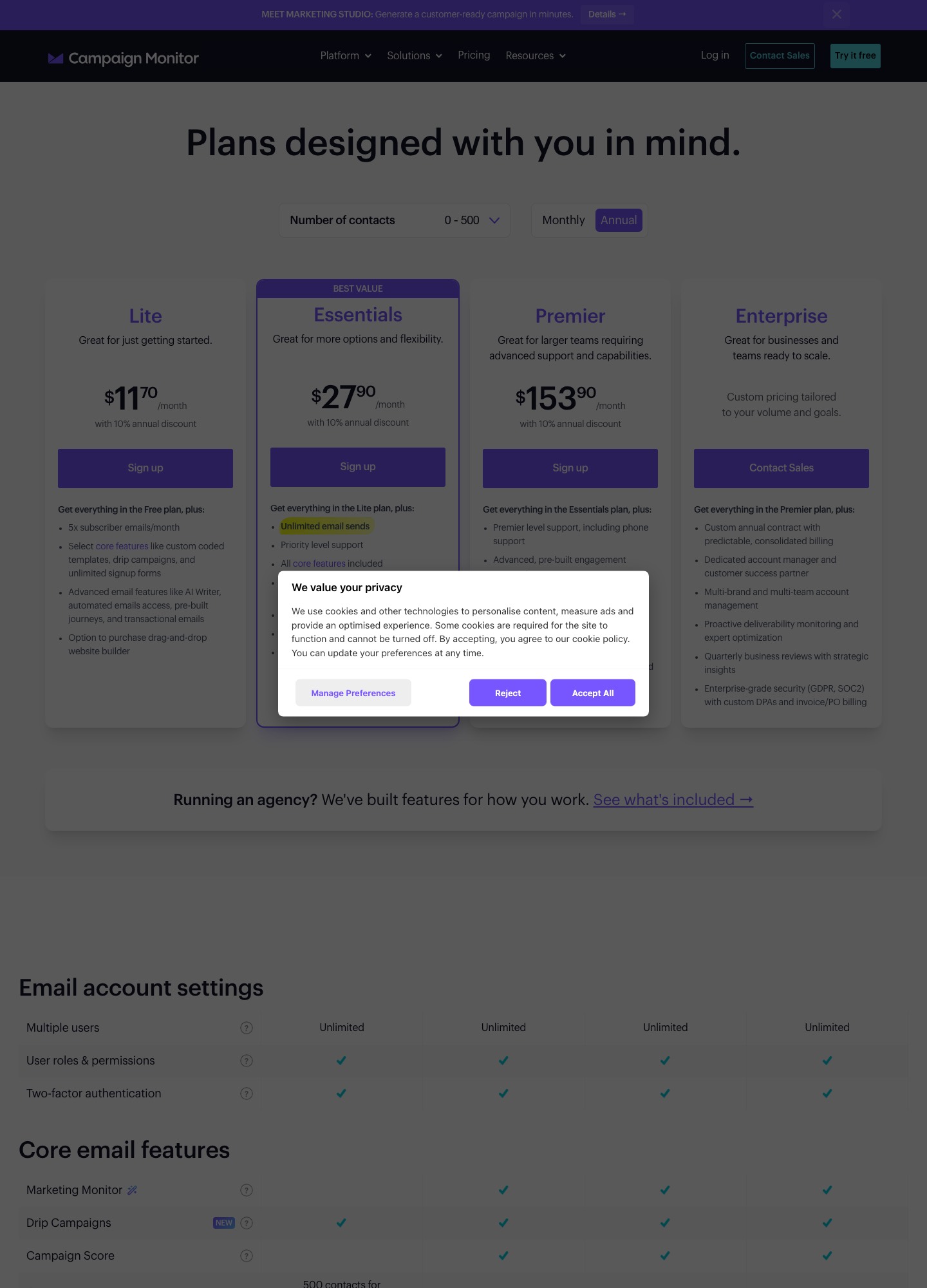
Campaign Monitor is a polished sender with a builder, drip campaigns and agency features. People leave it for two reasons that show on its own pricing page: Lite caps how many emails you can send, and the step up to the plan without a cap costs more than twice as much. This page says where to go instead, and what the move involves.
The short answer
For a small list and a tight budget, move to EmailOctopus or Brevo. For the broadest set of templates and integrations, pick Mailchimp, accepting its steeper price at higher list sizes. If you like Campaign Monitor as a sender but not as an editor, do not leave at all: add a builder such as Stripo, Beefree or Topol and export HTML into it. Stay if you rely on its agency sub-accounts and private labeling.
What Campaign Monitor charges, in two sentences
At the 0 to 500 contacts band with annual billing, Campaign Monitor's pricing page lists Lite at $11.70 a month, Essentials at $27.90 and Premier at $153.90, with Enterprise on request and the price rising with your contact selector. Plan limits and the full price table are on its own page, which we do not repeat here.
Why teams leave
Each of these is visible on the pricing page, not hearsay, and each matters only if it describes you.
- The send cap on Lite. Lite lists "5x subscriber emails/month". With 500 contacts that is 2,500 emails: a weekly newsletter (about 2,000) fits, a twice-weekly one (about 4,000) does not. The page says that above your limit you can upgrade or pay for the extra emails.
- The cost of removing the cap. Essentials lists unlimited email sends, unlimited automated emails, unlimited AI features and inbox preview, at $27.90 against Lite's $11.70. That is a 2.4x step at 500 contacts. The next step, Premier at $153.90 for phone support and advanced features, is another 5.5x.
- No standing free plan. The trial runs 30 days with 500 contacts and 500 emails. Small senders who want a free tier have no home here.
- Plan gating on checks. Inbox preview is listed as an Essentials benefit, so Lite users test through another tool.
- Ownership. The footer reads "Campaign Monitor by Marigold". If a vendor change in direction worries you, it is a reasonable moment to ask what else the market offers, though the pages read do not say anything is changing.
The alternatives, with prices
| Tool | Free plan | Paid entry prices | Best for |
|---|---|---|---|
| EmailOctopus | 2,500 subscribers, 10,000 emails a month | Pro $9 a month, billed yearly, at 500 subscribers and 10,000 emails | Newsletters on a minimal budget |
| Brevo | 300 emails a day | Starter $9, Standard $18 a month, each from 5,000 emails | Daily-limited free tier with automation on Standard |
| MailerLite | 250 subscribers, 2,500 emails a month | Comfort $12 monthly or $10.80 annual; Power $25 or $22.50, at 500 subscribers | Simple forms and newsletters |
| Mailchimp | 250 contacts, 500 sends a month | Essentials $13, Standard $20, Premium $350 at 0 to 500 contacts; Standard from $100 at 2,501 to 5,000 | Biggest integration and template ecosystem |
| Mailjet | 6,000 emails a month, 200 a day, 1,000 contacts | Starter $9, Essential $19, Premium $29 a month | Teams that want an MJML-based editor |
The comparison is fair only at one size, because every vendor above scales its price with list size and the Campaign Monitor page I read shows the 0 to 500 band. At 500 contacts Campaign Monitor Lite ($11.70) is in the middle of the pack, Essentials ($27.90) is above every entry plan in the table except Mailjet Premium at $29 and Mailchimp Premium, and Premier ($153.90) is cheaper than Mailchimp Premium's $350. Take your own contact count to each vendor's selector before you decide.
Who should switch to what
A small-list newsletter writer. If you send a few thousand emails a month and need basic forms, EmailOctopus is the lean choice: its free plan covers 2,500 subscribers and 10,000 emails, with its own branding on emails and reports kept for 30 days. Pro at $9 removes the branding and keeps reports forever. EmailOctopus alternatives covers the other direction.
A store or service business that wants lots of integrations. Mailchimp's Standard at $20 (at 500 contacts) can create and send custom-coded templates, runs up to 200 automation flows and sends up to 12 times your contact count. Past 2,500 contacts it becomes much more expensive than the cheapest options, so model growth first. The tradeoff with a separate builder is covered in Mailchimp vs Beefree.
A team that sends daily and wants a free starting point. Brevo's free plan limits you to 300 emails a day, which suits steady small sends but not one big monthly blast to a large list. Its Starter plan removes the daily limit from 5,000 emails a month.
A team attached to MJML. Mailjet's editor is built on MJML, its Free plan allows 6,000 emails a month with a 200-a-day limit, and Essential at $19 gives 15,000 emails with unlimited contacts. See MJML alternatives for the code-side options.
An agency running client accounts. Campaign Monitor's agency feature list includes tiered sub-accounts, private labeling, markup options for billing clients and template and automation sharing across sub-accounts. The pricing pages read for the other tools above list no equivalent, so agencies should weigh that before leaving.
The option nobody lists: keep the sender, change the editor
Campaign Monitor's own pricing page lists importing custom-coded HTML templates, either by upload or from the web, and a drag-and-drop builder with 100+ responsive designs. Stripo's integration list names Campaign Monitor, as do Beefree's connectors and Chamaileon's integrations page. A builder at Topol PRO's $10, Stripo Basic's $20 or Beefree Professional's $30 gets you a better template workflow without moving contacts, automations or reports. If your complaint is the editor, this costs a fraction of a migration. Our Stripo alternatives and Stripo vs BEE Free pages compare the builders.
What a migration involves
- Lists and consent. Export subscribers with their status and consent source, then import them into the new tool as subscribed, and bring the unsubscribed and bounced addresses across as a suppression list so they are never mailed again.
- Templates. Custom-coded HTML moves as files. Templates built in a drag-and-drop editor may not carry their editable structure, so export HTML, rebuild the header, footer and two or three body layouts in the new tool, and send tests to your main mail clients.
- Automations. Rebuild each journey by hand. List triggers, delays and branching in a document first, since the new tool will name them differently.
- Forms and integrations. Replace embedded signup forms on your site. Campaign Monitor lists 250+ integrations, so inventory yours and check each against the new vendor.
- Sending domain. Add the new sender's SPF and DKIM records before the first send and keep the old ones until the cutover is over.
- Transactional mail. Campaign Monitor's Lite plan lists transactional emails among its advanced features. If you use them, you need a sender with an API, which is a different shopping list from a newsletter tool.
Run the old and new tools in parallel for one sending cycle if you can: send the regular campaign from the new tool to a small segment first, compare delivery, then move the rest. Reporting history does not migrate, so export what you need for the record.
Stay if…
- You are on Essentials and the unlimited sends, inbox previews and priority support are in use every month.
- You depend on agency sub-accounts, private labeling or its journey builder.
- Your only complaint is the editor, which an outside builder can fix at $10 to $30 a month.
FAQ
Does Campaign Monitor have a free plan?
Not an ongoing one. Its pricing page offers a 30-day free trial limited to 500 contacts and 500 emails. After that the cheapest plan is Lite, listed at $11.70 a month on annual billing at the 0 to 500 contacts band. If you need a free tier you can stay on indefinitely, EmailOctopus (2,500 subscribers and 10,000 emails a month), Brevo (300 emails a day), MailerLite and Mailchimp all list one.
Why does my Campaign Monitor plan stop sending before the month ends?
Lite caps sends at 5x your subscriber count a month, which is 2,500 emails at 500 contacts, and the page says that if you send above your limits it will notify you and offer an upgrade or payment for the additional emails. Essentials is the plan listed with unlimited email sends. If you mail a small list often, compare the cap against your real monthly volume before assuming Lite is enough.
Can I keep Campaign Monitor and just change the editor?
Yes, and for design-led teams it is the cheapest change. Campaign Monitor says it can import custom-coded HTML templates, and Stripo, Beefree (now RGE Studio), Chamaileon and Litmus all list Campaign Monitor as an export target on their own pages. A builder at $10 to $30 a month sits on top of the sender you already have, so contacts, automations and reports stay where they are.
What is the cheapest replacement at 500 contacts?
On the pages read for this comparison, Brevo Starter and EmailOctopus Pro are both $9 a month (EmailOctopus billed yearly), MailerLite Comfort is $10.80 on annual billing, Mailchimp Essentials is $13 and Standard $20. Campaign Monitor Lite is $11.70 and Essentials $27.90. Prices rise with contact count at every vendor, so check your own list size before deciding.