EmailOctopus alternatives: the few cases where moving beats staying
By Mara Levin · Updated October 7, 2026 · Vendor pages and prices checked that day
EmailOctopus is hard to undercut: a free plan for 2,500 subscribers and 10,000 emails a month, then Pro from $9. Most people who look for an alternative are not escaping its price. They want a different feature mix, a better editor, or they have outgrown the free plan. This page sorts those cases and prices the options.
The short answer
Stay if you are on the free plan and under 2,500 subscribers: no alternative in this comparison matches its limits at $0. Move to Mailchimp or Brevo if you need deeper automation or a wider integration list than a newsletter tool offers. If the editor is the complaint, the cheaper move is to keep EmailOctopus and design in Topol ($10), Stripo ($20) or Beefree ($30).
What EmailOctopus charges, briefly
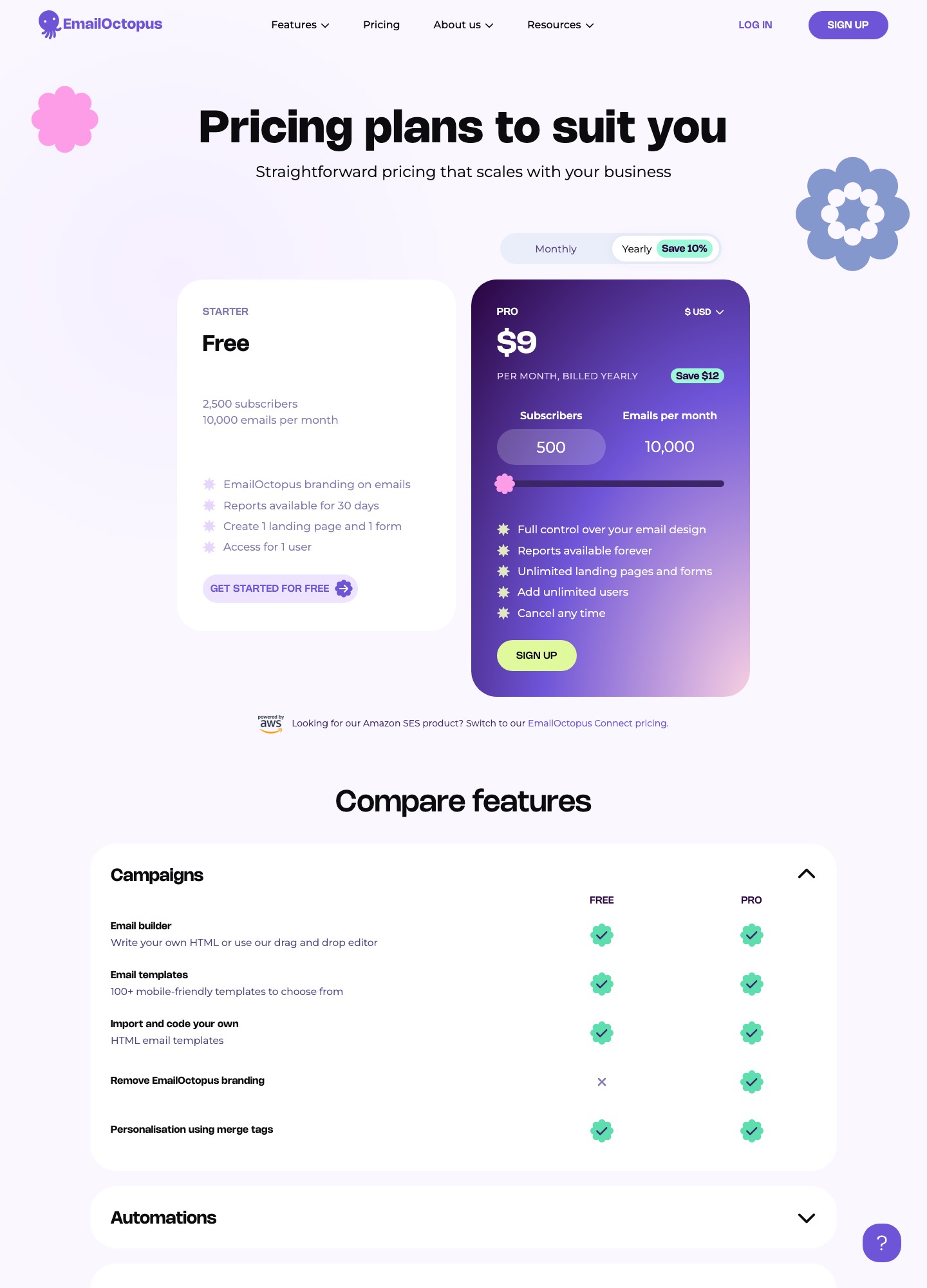
EmailOctopus's pricing page lists Starter at $0 and Pro at $9 a month billed yearly (with a yearly saving of 10%) at 500 subscribers and 10,000 emails a month, rising on a slider as your list grows. The full feature table is on the vendor page, so we link rather than copy it.
Honest reasons to leave
- You passed 2,500 subscribers. The free plan stops there, and the Pro slider takes over. At the default position it shows $9, but the page I could read did not expose the price at your list size, so look at the live slider before you compare.
- You want your own branding. Starter puts EmailOctopus branding on your emails. Removing it needs Pro.
- You need history or collaborators. Starter keeps reports for 30 days and gives one user, one landing page and one form. Pro lists reports available forever and unlimited users, landing pages and forms.
- You want a bigger toolbox. If you need ecommerce events, CRM features or a long list of connectors, a general marketing platform is a better home. This is a judgment about category and not a claim from the EmailOctopus page, so check the specific connector you rely on.
Prices side by side
| Tool | Free plan | First paid prices |
|---|---|---|
| EmailOctopus | 2,500 subscribers, 10,000 emails a month | Pro $9 a month billed yearly, at 500 subscribers |
| Brevo | 300 emails a day; storage for up to 100,000 contacts | Starter $9; Standard $18 a month, each from 5,000 emails |
| MailerLite | 250 subscribers, 2,500 emails a month | Comfort $12 ($10.80 annual); Power $25 ($22.50 annual), at 500 subscribers |
| Mailchimp | 250 contacts, 500 sends a month | Essentials $13; Standard $20; Standard from $100 at 2,501 to 5,000 contacts |
| Mailjet | 1,000 contacts, 6,000 emails a month, 200 a day | Starter $9 (8,000 emails); Essential $19 (15,000 emails); Premium $29 |
A list of 2,500 and four sends a month
That is 10,000 emails, exactly the Starter allowance, and it is the example where the free plan is hardest to beat. Check each alternative against it. Mailchimp Free allows 250 contacts, so it is out. MailerLite Free allows 250 subscribers, so it is out too. Brevo Free's 300-emails-a-day limit means a single send to 2,500 subscribers takes about nine days (2,500 ÷ 300 = 8.3), so four sends cannot fit in a month. Mailjet Free stops at 1,000 contacts. If you are happy with branding on your emails and one user, EmailOctopus Starter is the only plan here that works at $0.
A list of 500 and a weekly newsletter
Four sends to 500 people is 2,000 emails, well under every allowance above, so the free plan is the answer unless you need Pro features. Taking the paid entry points at 500 contacts: EmailOctopus Pro $9 billed yearly, Brevo Starter $9, MailerLite Comfort $10.80 on annual billing, Mailchimp Essentials $13 and Standard $20. The spread is $11 between the cheapest and the dearest, which is about $132 a year. Features, not price, should decide here.
Who should move to what
To Mailchimp, if you need automation and integrations. Standard lists up to 200 automation flows, up to 12 times your contacts in monthly sends, five seats and custom-coded templates you can create and send. Its cost climbs fast, with Standard starting at $100 a month once you pass 2,500 contacts, against EmailOctopus's slider. Read Mailchimp vs Beefree if you also want to use an outside builder.
To Brevo, if you send small volumes daily and want a free tier with room to grow. Its free plan stores up to 100,000 contacts and sends 300 emails a day, and Starter at $9 removes the daily cap. Standard at $18 adds automation and A/B testing according to its pricing page.
To MailerLite, if simplicity matters more than a big free tier. Its free plan is smaller (250 subscribers), but Comfort and Power are priced close to EmailOctopus Pro at the 500-subscriber step.
To Mailjet, if you want an editor built on MJML. Its Free plan gives 6,000 emails a month for 1,000 contacts, Essential gives 15,000 emails with unlimited contacts at $19. See MJML alternatives for the context.
The cheaper move: keep it, improve the design
EmailOctopus lets you write your own HTML or use its drag-and-drop editor, offers 100+ templates and lets you import and code HTML templates on both plans. If the template library or layout control is what bothers you, pairing it with a builder costs less than a migration. Topol PRO is $10 a month with unlimited HTML exports, Stripo Basic is $20 with 50 exports, and Beefree Professional is $30 ($25 billed yearly). So EmailOctopus Pro plus Topol PRO is $19 a month at 500 subscribers, against $20 for Mailchimp Standard alone. The catch: none of the builder integration lists I read name EmailOctopus, so every export is a download and import. Compare builders in Topol vs Stripo and Stripo alternatives.
Moving out: a short plan
Start with reports, because Starter keeps only 30 days of them: export anything you need for the record before you change tools. Then export subscribers with their status, bring unsubscribes and complaints across as a suppression list, and import everything into the new platform before your next send. Recreate your single landing page and form on the new side and swap the embed on your site. Add the new sender's authentication records to your domain, send a first campaign to a small slice of the list and compare delivery to your last EmailOctopus send. Cancel the old plan only after one full cycle has gone cleanly, and confirm in your account that the subscription is closed so nothing keeps billing in the background.
Stay if…
- You are under 2,500 subscribers and 10,000 emails and can live with branding and one user.
- You are on Pro and the price at your slider position is lower than the alternatives for the same list.
- Your only complaint is template design, which a builder can fix without moving anything.
FAQ
Is EmailOctopus really free?
Its Starter plan is $0 for up to 2,500 subscribers and 10,000 emails a month. The limits listed on the pricing page are EmailOctopus branding on your emails, reports kept for 30 days, one landing page and one form, and access for one user. Pro removes the branding and the report limit and adds unlimited landing pages, forms and users, at $9 a month billed yearly at the default 500-subscriber slider position.
What happens to my bill as my list grows?
Pro is priced by a subscriber and email slider, and the page promises automatic upgrades as your list grows, so you do not need to change plan yourself. That is convenient but also means the bill moves without a decision, so check the slider for your real subscriber count each quarter. Above 500,000 subscribers the page says to contact the company for a quote, and it lists a 20% lifetime discount for non-profits.
Can I keep EmailOctopus and improve the design?
Yes. The pricing page lists a builder where you can write your own HTML or use the drag-and-drop editor, 100+ templates, and importing or coding your own HTML templates on both Starter and Pro. None of the builder integration lists read for this page (Stripo, Beefree, Chamaileon) names EmailOctopus, so the route is downloading the HTML from the builder and importing it.
What is EmailOctopus Connect?
EmailOctopus's pricing page points to a separate Amazon SES product with its own pricing page, for people who want to send through SES rather than on the standard plans. Its prices are not on the page examined here, so check that page directly if volume is your reason for looking elsewhere.